
Sifting Through the Gray Areas
Thoughts about Project Failure Files Ep.78

After listening back to this episode, I found myself shaking my head a few times. Not at Sharon. Not at the topic. At myself.
Because if I’m being honest, some of the ethical gray areas I’ve seen in my career did not feel gray at the time. Some of them felt practical. Occasionally even compassionate.
That’s the part that keeps sticking with me.
We talked a lot about how ethical failures usually start small. And that sounds obvious when you say it out loud. Of course it does. No one wakes up and decides to tank their integrity in one dramatic move. But listening back, I kept remembering moments where someone on the team, or in leadership, justified something because it was efficient, or because they trusted someone, or because it was an effort to be more “equitable.”
I have absolutely said, “It’s fine. We’ll fix it later.”
But later has a funny way of never arriving.
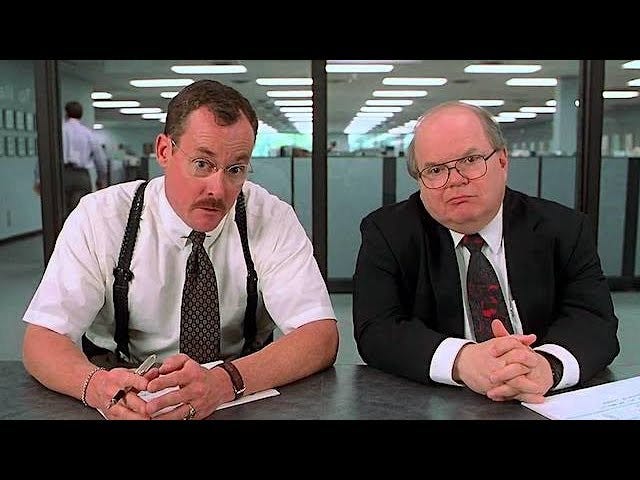
The other thing that stood out to me was the fairness conversation. I’ve worked in environments where everything was technically defensible on paper. There was always a reason someone got the opportunity, the training, the budget, the stretch assignment. A couple of times in my career I have been brought in as the “Bob” (the name of the two consultants hired to reduce headcount in the movie ‘Office Space’) to assess people and process and technology and to make recommendations. I was the clean up guy, and I tried my best to do what I thought was fair and right.
But perception has gravity.
If people see patterns, they start connecting dots. Even if you were completely unaware of those patterns. And once someone believes the system favors certain people, even if that was not the intent, the energy shifts. You can feel it. Conversations get shorter. Trust gets thinner. People stop volunteering. They stop pushing. Or they quietly start looking elsewhere.
That kind of damage rarely shows up on a dashboard. It shows up in tone.
And then there is the data and compliance side of this, which for me is less philosophical and more blunt. I’ve been in rooms where someone brushed off a privacy concern because it was inconvenient. I’ve also been the person brought in later to clean up (I see a pattern) what someone else called “no big deal.”
It is almost always a big deal.
What struck me listening back is how often these situations are not about ignorance. They are about pressure. Deadlines. Politics. Loyalty. Wanting to be helpful. Wanting to move fast. Wanting to win.
None of those are bad instincts. They just get dangerous when they start outranking integrity.
I also keep coming back to something Sharon said about culture being what happens when nobody is watching. I’ve heard many variations on that one, and it always lands with me. Because most of us know what the policy says. The real question is what we do when following it is inconvenient, or slower, or unpopular.
As I shared in the episode, I have left a company over this before. Not because of a massive scandal. Because of a moment where something clearly crossed a line and leadership chose to shrug instead of fix it. That shrug told me more about the culture than any mission statement ever could.
And that is probably the simplest takeaway I have from listening to this episode again.
Ethics is not about being perfect. It is about noticing when you are rationalizing. It is about paying attention to the tiny compromises that feel harmless. It is about catching the drift before it becomes the norm.
Because once something becomes normal, it gets very hard to call it out without sounding like the problem.
Anyway. This one is uncomfortable for a reason.
If you listen to it and feel a little uneasy, that might actually be the point.
You can watch the entire episode here:
We would love to see you at the next episode on February 23rd at 9am Pacific as we discuss Squeezing the Last Drop from the Team (#ProjectFailureFiles Ep.79). You can register on LinkedIn to get the reminders, or find us on YouTube, Facebook, and Twitter.