
Stop Building Fiefdoms
My latest thoughts from the Project Failure Files

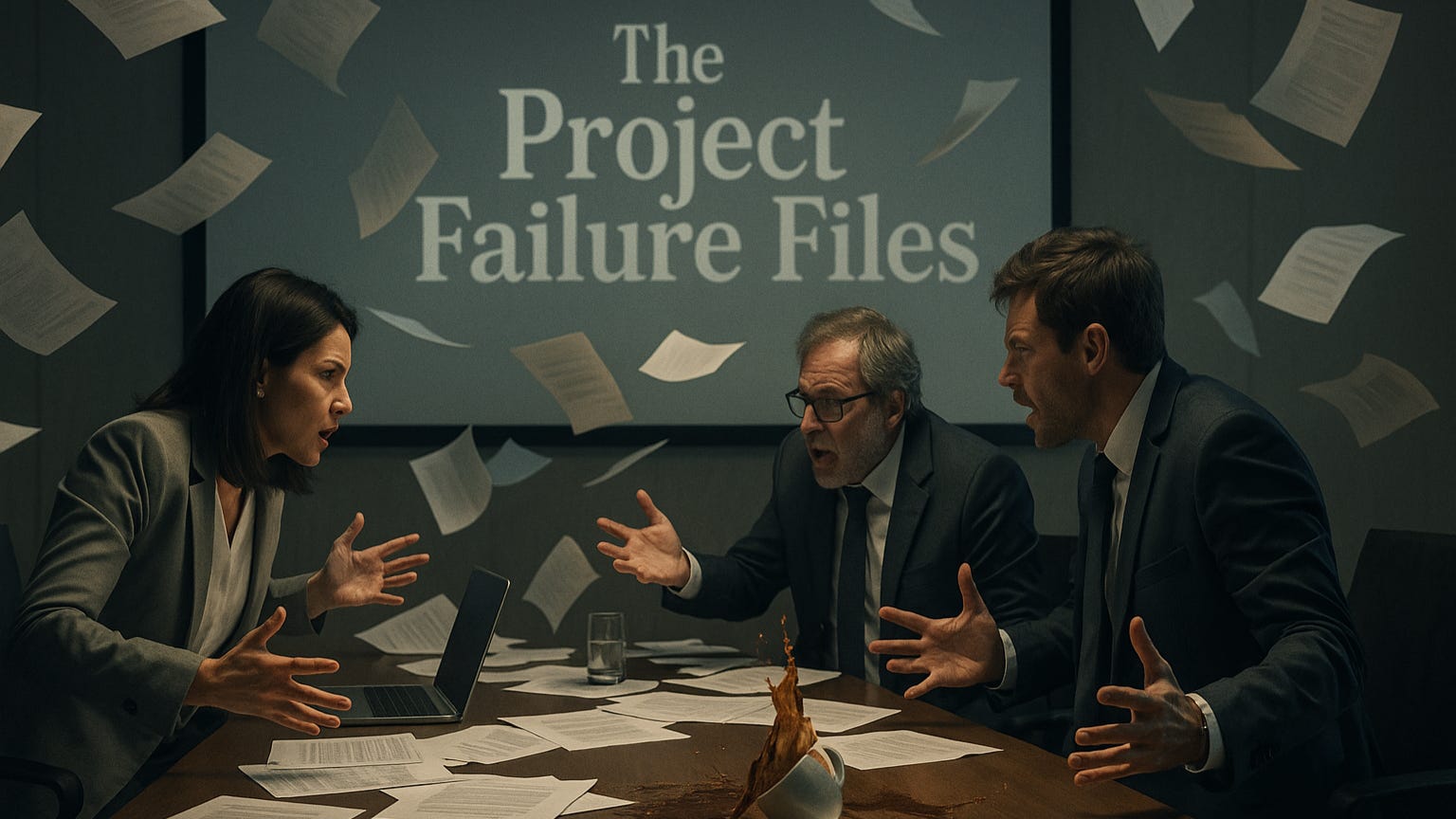
There’s a moment in a lot of organizations where someone looks at an org chart and says, “See? We’re lean. We’re efficient.” And what they really mean is: we’ve stacked a small mountain of humans on top of one manager and we’re calling it leadership.
That’s the heartbeat behind the latest episode of the Project Failure Files — When More Isn’t Merrier. And if I’m honest, this episode hit me in that specific way episodes do when you’re not just talking about an idea, you’re revisiting a version of yourself that survived it.
We joked around a bit about how in a past company, a manager I mentioned was “building a fiefdom.” That whole episode stuck with me because it’s one of those phrases that’s funny until you realize it’s also painfully accurate. Big headcount under one person can look like authority. It can look like trust. It can look like scale. But in practice, it often looks like a slow, quiet erosion of leadership quality, and everybody feels it before anyone admits it.
I’ve been the person with too many direct reports. Not because I chased it, but because I kept getting handed it. Reorgs. Mergers. “Temporary” situations that somehow lasted long enough to become a lifestyle. I mentioned on the episode that I’ve had as many as 20 direct reports for a few months, and the best way I can describe it is this: you stop managing people and start managing interruptions. You become a human switchboard. Pop in. Pop out. Solve the urgent thing. Move to the next urgent thing. And the truly important work, coaching, development, actually knowing what’s going on in someone’s world, becomes the thing you keep meaning to get back to.
That’s the trap. It’s subtle at first.
One-on-ones get shorter. Then they get moved. Then they get temporarily shifted from weekly to biweekly, because everyone’s busy and we’re all adults here. Conversations turn into status updates. And if you’re the manager, you can tell yourself, “I’m still meeting with everyone.” But if you’re one of the direct reports, the internal story often becomes, “I’m on my own.”
Not because the manager does not care. Because time is a nonrenewable resource and leadership is not infinite.
Sharon and I kept circling back to something that does not get enough airtime: the cost of context switching. It is the invisible tax that compounds quietly until everything feels harder than it should. When you have five to seven people, you can usually stay oriented. You can carry their projects, their personalities, their goals, their stressors, the weird dynamic with that one stakeholder, and the fact that their kid has been sick for a week. You can still be human with them.
When you have ten, twelve, fourteen, you start losing the thread.
And the first thing you lose is attention.
I said in the episode that I have watched companies confuse availability with leadership. Someone is always in meetings, always on, always responding to pings, and everyone assumes that means they are a strong manager. But being busy is not mentorship. Being visible is not coaching. Being in the middle of everything is not the same as developing the people who make everything work.
The consequences show up later, when it is more expensive.
Performance issues do not get caught early because no one has enough relationship equity to be blunt. Strong performers plateau because nobody has time to challenge them properly. People disengage quietly, not with a big speech, just a slow fade into doing the minimum. And then leadership pipelines dry up because developing future leaders requires the one thing overloaded managers do not have: bandwidth.
One of the memories that always comes back for me is from a role where my own team was fine and stable, but my peers were drowning. Their spans of control were so wide that basic decisions became logjams. Not because anyone was incompetent, but because everyone was overextended. And that is the part people miss. This problem does not stay contained to one manager’s world. It spreads sideways. It slows cross team work. It creates organizational fragility. You become one key person’s sick week away from chaos.
That is not scale. That is a single point of failure with a calendar invite.
What I appreciate about this conversation, and why I think it matters, is that neither Sharon nor I are trying to romanticize small teams or pretend growth is bad. Growth is great. Scaling is necessary. But if your approach to scale is “give one person more people,” you are not scaling leadership. You are scaling risk.
The fix is not heroic effort. It is structural honesty.
Keep one-on-ones sacred. Not because it is trendy, but because it is the first indicator that your span of control is breaking. When those meetings start becoming optional, everything else becomes optional too. Trust. Candor. Development. Retention.
And if you are feeling stretched, do the gut check we mentioned in the episode. Do you actually know what your people are working toward right now? Not just what they are doing this week, but what they are building toward. What they are trying to learn. Where they are stuck. If the answers are fuzzy, that is not a moral failing. It is a signal that the structure needs to change.
Sometimes that change looks like rebalancing. Sometimes it is creating team leads. Sometimes it is temporarily promoting someone into a lead role for a project and then letting them step back afterward. I have done that once. It worked, and it also caused some drama, because humans are consistent that way. But done correctly, delegation is not handing off work. It is building redundancy. It is creating understudies. It is building resilience.
And here is the line I keep coming back to, because it is the one I wish more org charts could understand:
The best measure of leadership is not how many people report to you.
It is what happens to those people over time.
Do they grow? Do they stay engaged? Do they feel supported? Do they become leaders themselves?
If the answer is no, if your team is managed but not developed, then more is not merrier. It is just heavier.
And eventually, something breaks. Usually quietly. Usually first in the places no dashboard tracks.
So if you are in one of those seasons where you have inherited extra people, or your organization has decided that flat is fashionable, take this episode as a permission slip to ask for something better. Not for your comfort, but for your team’s sustainability.
Because leadership is not a fiefdom.
It is a relationship. And relationships do not scale on spreadsheets.
Enjoy the latest episode:
And be sure to watch next week’s episode: Ignoring the Moral Compass (Feb 16th)